
When Technology Meets Craftsmanship, What Can Human Hands Still Do Best?

TECH MEETS CRAFT — Where the Precision of Technology Meets the Artistry of the Human Hand

After the previous challenge, where CREW CUTTERS had just nine days to transform a creative concept into a finished piece of jewelry, this next challenge brought us face-to-face with another important question for designers and craftspeople.
As technology continues to advance, where does the true value of human craftsmanship lie?
In The Cut Reality, the TECH MEETS CRAFT challenge invited each team to explore how technology and traditional craftsmanship could work together.
For CREW CUTTERS, the assigned technique was Metal Engraving.

As part of the challenge, the production team also arranged an on-site learning experience at Rajamangala University of Technology Phra Nakhon, North Bangkok Campus.
Jitapa Auramornrat of Siamwell, Worapong Junpreuk of Luvia, and Areeya Chaiwan of Minella represented CREW CUTTERS in exploring the process of machine-assisted metal engraving.
The experience allowed them to discover how technology could help craftspeople achieve greater precision, refine intricate details, and create new possibilities in metal textures and surface treatments.
Yet, as the team reflected on what they had learned, another question emerged:
How can we embrace new tools without losing the unique beauty and character of work created by human hands?
From the Lotus Pond to B.U.A. — Bloom of Unique Art

The central concept for this challenge was developed by Thanawat Panachaweng of Charites Gems, who drew inspiration from “Lotus Pond” by Thawee Nandakwang, a National Artist in Visual Arts (Painting), as the starting point for the collection.

Rather than simply recreating the lotus pond painting as a piece of jewelry, the team chose to explore a deeper idea within the artwork: “The Beauty of Differences.”
When we look closely at a real lotus pond, no two leaves are ever exactly alike.
Some are young and delicate, while others have matured with time. Some carry natural marks and imperfections, while others gradually change color as the seasons pass.
Yet, when all these leaves come together, their differences do not diminish the beauty of the pond. Instead, it is precisely these differences that create its unique harmony and beauty.

This Idea Became “B.U.A. — Bloom of Unique Art”

Each lotus leaf was designed with its own distinct color, material, texture, and crafting technique, before all these differences were brought together to form a single piece of jewelry.
We did not try to make every element look the same. Instead, we allowed each one the freedom to express its own unique beauty.
Looking back, this philosophy also reflects the spirit of CREW CUTTERS.
Every member brings different knowledge, skills, and areas of expertise to the team. Yet, when we combine what each person does best, we can create something that none of us might have been able to achieve alone.
When Every Lotus Leaf Is Crafted Differently

What makes B.U.A. particularly fascinating is that its individual elements are not all created using the same materials or techniques.
At the heart of this challenge was Metal Engraving.
The team incorporated Air Graving, a pneumatic engraving technique, to create intricate lines, grooves, and textures on metal surfaces, with every movement guided by the hands of a skilled artisan.
While the tool allows for greater precision and finer detailing, it is still the craftsperson who decides where each line should flow, how deeply it should be engraved, and what character the finished surface should reveal.
This was never about a competition between machines and human hands.
Instead, it was about allowing both to contribute what they do best.
From Discarded Glass Bottles to Lotus Leaves in Jewelry
Another fascinating element of B.U.A. was the creation of green lotus leaves from discarded green glass bottles.
Rather than allowing these leftover materials to be dismissed as waste with no remaining value, the team saw an opportunity to give them a new purpose.
The team explored ways to upcycle these discarded materials, carefully carving and engraving grooves by hand to transform ordinary glass into something of renewed value.
Through this process, a material that might otherwise have been overlooked was given a second life as part of a contemporary jewelry creation.
Akechai Sankumgon of FINE helped coordinate the production process, turning the team's vision of repurposing discarded glass into a tangible piece of jewelry.
For us, the most fascinating part was not simply discovering what the material used to be, but asking a deeper question:
Can we recognize new possibilities and value in something that others may no longer consider valuable?
Moonstone — Like a Drop of Water Resting on a Lotus Leaf
The team also incorporated Moonstone as another meaningful detail within the design.
With its soft, luminous glow, the gemstone evokes the delicate beauty of a water droplet resting gently on the surface of a lotus leaf.
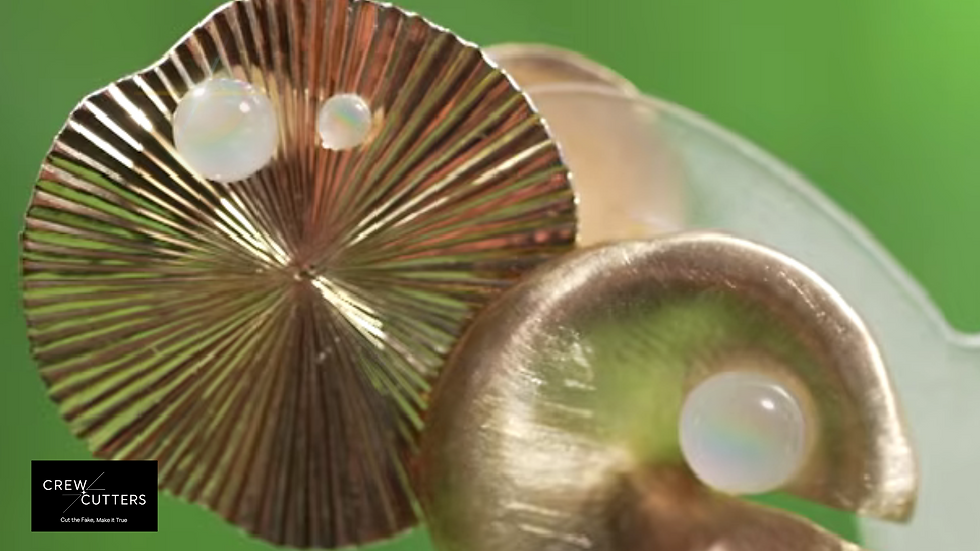
This small yet thoughtful detail demonstrates that the choice of gemstones was not based solely on their color or visual beauty. Every element was carefully selected to connect back to the story of the lotus pond.
For the gemstone setting and arrangement, Areeya Chaiwan of Minella and Jitapa Auramornrat of Siamwell took responsibility for ensuring that the gemstones harmonized beautifully with the structure and intricate textures of the jewelry.
THI — A Material That Allows Time to Become Part of the Design
Another important element was introduced byPonK Pornsmithikul of Ponk Smithi, who brought a distinctive material into the collection:
THI — Thailand Copper No.1, a specially developed Thai copper alloy designed to gradually change color over time.

What makes this material particularly fascinating is that the team did not attempt to prevent it from changing over time.
Instead, we embraced the idea that change itself could become part of its beauty.
Just like lotus leaves in nature, which never retain the same color forever, the material gradually develops its own marks, character, and unique appearance as time passes.
Rather than seeing time as something that makes a piece look “old,” we explored the possibility of allowing time to become part of the creative process, continuously shaping and transforming the artwork.
When Different Areas of Expertise Come Together as One Masterpiece
CREW CUTTERS also began exploring how B.U.A. could evolve beyond the competition.
If the collection were to continue its journey, how could it grow while preserving its artistic identity?
The team proposed three distinct levels of artistic creations.
Masterpiece would represent one-of-a-kind works created for collectors seeking truly exceptional pieces.
Collector Limited would feature limited-edition creations, each accompanied by an individual serial number and documentation verifying its provenance.
Artist Studies would offer a more accessible entry point into the world of B.U.A., inviting new audiences to discover the collection and potentially inspiring the next generation of art jewelry collectors.
With this approach, the target audience was not defined simply by age or income, but by what people truly value.
This included collectors who appreciate art, craftsmanship, and cultural narratives, as well as younger generations seeking contemporary jewelry with a distinctive identity, a meaningful origin, and the ability to reflect their personal values.

For Be'Shine, this was another valuable lesson.
The value of craftsmanship does not have to be communicated through the words “handmade” alone.
Its true worth can also be found in who created the piece, how it was made, where its materials came from, how many pieces exist, and how the story behind each creation can be preserved and passed on.
When the Beauty of Differences Led CREW CUTTERS to First Place
For this challenge, Pawaranan Sinlapawanich of Morakot Gallery and Natsudsama Pongkemmanun of Orithai represented CREW CUTTERS in presenting B.U.A. to the judging panel.
And this time, the team achieved first place in the TECH MEETS CRAFT challenge.

One of the comments the team received from the judges was that B.U.A. successfully addressed the challenge's 70% Technology requirement, while maintaining a harmonious balance with craftsmanship.
Some judges particularly appreciated the storytelling behind the lotus leaves and recognized the potential for the collection to evolve onto the international stage.
Yet, beyond the jewelry itself, another element stood out just as strongly:
The teamwork of CREW CUTTERS. Because B.U.A. was never the result of one person's expertise alone.
An idea from one person.
A material developed by another.
A technique contributed by someone else.
Production handled by another.
Gemstone setting by another.
And the presentation brought to life by others.
Not everyone needed to do the same thing.
What mattered was that each person understood how their contribution helped bring the same shared vision to life.
What Be'Shine Learned from B.U.A.
For Be'Shine, the most important lesson from this challenge was never about deciding whether Technology or Craftsmanship is better.
Instead, it was about understanding where each should play its role.
Technology can enhance precision, open up new creative possibilities, and make complex ideas achievable.
Meanwhile, human hands continue to bring experience, judgment, and emotion into every detail of the work.
This philosophy connects directly to the foundations of Be'Shine, particularly our expertise in gemstone cutting and the craftsmanship behind every stone.
Gemstone cutting is not simply about shaping a gem into something beautiful.
It requires a trained eye, deep understanding, and years of experience to recognize the unique characteristics and potential of each piece of rough material.
After all, nature never creates two gemstones that are exactly alike.
What we hope to carry forward from this experience is not the need to choose between technology and craftsmanship.
Rather, it is the belief that technology should be used to expand what human hands can achieve, without removing the human qualities that give the work its meaning.
Because in a world where tools are becoming increasingly capable of producing perfection, the true value of craftsmanship may no longer lie in making every piece as identical as possible.
It may lie in giving every creation a reason to be unlike any other.
And perhaps, that is exactly what B.U.A. has been trying to tell us all along.
Differences are not imperfections that need to be corrected. When understood and brought together with intention, they can become the very source of a creation's value.
— Be'Shine
Follow the journey and discover the creations of CREW CUTTERS in EP. 7 - The Cut Design Identity Challenge - ศึกประชันอัตลักษณ์ เจียระไนฝันสู่เวทีโลก


Comments